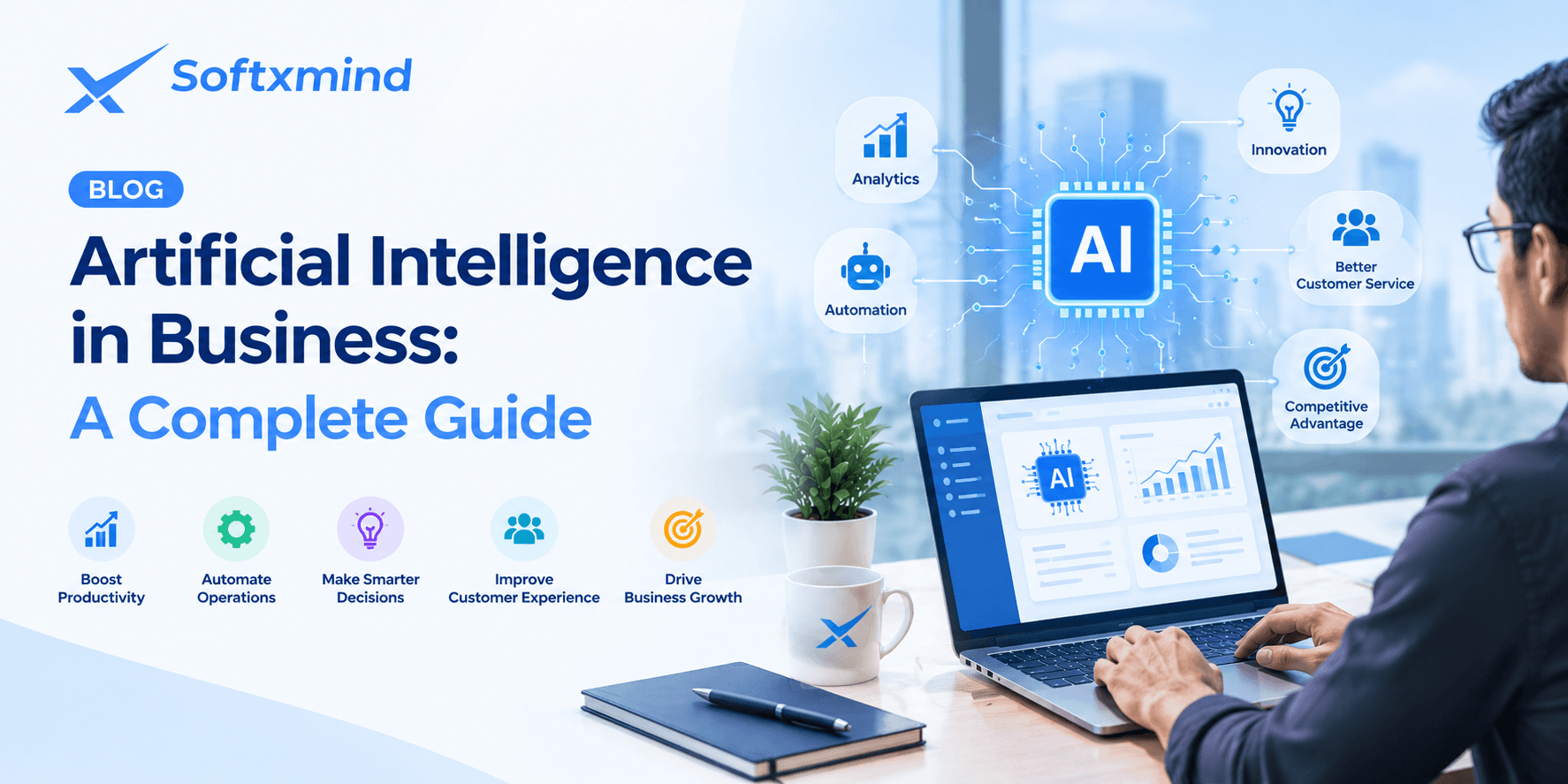
Artificial intelligence (AI) in business refers to using technologies like machine learning, natural language processing (NLP), generative AI, and predictive analytics to automate work, optimize operations, and guide strategic decisions.
If your company is still not harnessing the benefits of AI in business, there is a significant risk you will lag behind your competitors. AI has witnessed immense growth on an unprecedented scale which is clearly visible from the Pulse Poll of 254 technology leaders conducted by EY in April 2023. This survey has found that 90% of respondents leverage AI models such as Bing Chat and ChatGPT, and 80% are planning to invest more in AI in the coming years.
This survey speaks volumes to the growing number of companies embracing AI in businesses. Since the exponential growth of AI and business, commercial firms can no longer ignore its underlying potential.
AI can deliver a substantial amount of qualitative change to any size of business across industries and create new opportunities. Financial firms, educational institutions, the automotive industry, construction businesses, the healthcare sector, and relatively all tech enterprises are using AI to a great extent.
It’s high time for startups, SMEs, and enterprises to embrace AI. Here is a complete guide to help you adopt AI business solutions effectively. This guide will give you a comprehensive analysis of AI and ML in business, explaining why these emerging technologies have been a dire necessity of the modern business world while giving some rich real-world examples and use cases to inspire you to adopt AI solutions. This guide will help discover several ways for AI integration in business.
Understanding AI Business: Strategies for Navigating Digital Change
Artificial intelligence encompasses various technologies such as Machine Learning, Deep Learning, Natural Language Processing (NLP), Computer Vision, Robotics Process Automation, etc. While all these technologies are closely related, they have distinct functions and use cases in businesses. So, before we hop on to the different applications of AI in business, let’s clarify the terminologies and understand the core ideas they carry.
Artificial Intelligence
AI is a field of computer science where the simulation of human intelligence processes such as reasoning, learning, and self-correction is performed by machines.
Machine Learning
Machine learning is one of the various applications of artificial intelligence based on the concept that systems can learn from given data. With specific repetitive tasks, the systems can evolve with nominal manual effort.
Deep Learning
Deep learning explicitly belongs to the group of machine learning methods. It is an approach to building and training neural networks to learn and generate outputs that require no supervision.
Natural Language Processing (NLP)
Natural Language Processing (NLP) enables computers to understand and interpret human language. It facilitates smooth interactions between humans and intelligent machines through text and speech.
Computer Vision
Computer Vision enables machines to understand and interpret visual information from images or videos. For instance, the retail industry utilizes computer vision to identify products, track inventory, and automate the checkout process.
Robotics Process Automation
Robotics process automation (RPA) encompasses the utilization of software bots to automate repetitive and rule-based tasks such as data entry and analysis, invoice processing, and so on.
Top 10 Use Cases of AI in Business
There are many ways organizations can use AI and make their business process more effective and much simpler. For instance, you can use it for product recommendations, automated content marketing, predicting sales, customer support etc. Furthermore, AI business solutions strengthen cyber security systems, reduce energy costs, perform data analysis, and help an organization become more customer-centric. Below are the top ten uses of AI in business.
1. Chatbots for Customer Support
A chatbot is an AI software that imitates human conversation with customers over mobile apps, websites, smartphones, and other digital devices. In simple words, it is an AI-powered digital assistant that businesses use to resolve customer queries. Now that users want quick, easy, and personalized solutions to their queries, chatbots have become the most efficient way to communicate with them.
Chatbots are directly contributing to digital business growth and are among the most promising trends in customer engagement and user experience. It is why the global chatbot market is expected to reach $1.25 billion by 2025.
2. Sentiment Analysis
Sentiment analysis is one of the most impressive uses of AI in business that can be leveraged to monitor and analyze customers’ opinions and emotions through various texts. The texts can be in any form taking place on a website, social media platforms, product or service comments, etc. Using AI for sentiment analysis, businesses can analyze vast amounts of data and understand how customers feel about their services or products.
Furthermore, this data can be refabricated to determine customer preferences and fulfill demands. The applications of AI in social media, sports, healthcare, real estate, and eCommerce for analyzing sentiments and emotions have proven to be one of the biggest benefits of AI in business.
3. Sales Forecasting
Sales forecasting is a vital process of estimating and predicting future sales for long-term business growth. Through sales forecasts, one can detect potential problems and take proactive measures to avoid them. Also, accurate sales forecasts can help businesses calculate the probability of future customer purchases and predict long and short-term performance.
Sales forecasting can be done by implementing AI-based CRM software in the business. It helps analyze CRM data, purchase history, etc., and find out how each data element, such as email, customer calls, etc., is related to sales performance.
4. Price Optimization
Even if we live in the age of “value,” but “price” is still the king. Price of a product or service is the primary factor that makes customers stay connected with a brand. There are certain factors that influence the price, such as brand reputation, product history, product demand, season, quality, operating costs, etc. Artificial Intelligence considered all the above factors when determining the optimal price of the product. In simple terms, AI can help you make the best price decisions for every product.
One real-time example of AI in price optimization is Uber. The AI makes the ride fare, route choice, and the nearest driver decisions. Similarly, eCommerce giants Walmart and Amazon rely on AI technology for cognitive pricing optimization.
5. Smart Cybersecurity
Only four Steps here:
Detect abnormal behaviour before it causes damage,
Faster and accurate make decisions regarding threats,
Prevent wasting time researching false alerts,
Improve company credentials.
Cybersecurity is one of the most crucial reasons why industries like retail, banking, automotive, telecom, etc. leverage AI technology in business. Thousands of credit card companies, financial firms, and medical institutions rely on artificial intelligence and machine learning for fraud detection.
Your business might exponentially face account takeovers, identity theft, malicious ransomware, etc., on a regular basis. AI cybersecurity software can save your business from such risks in several ways, including vulnerability management, network security, behavioral analytics, phishing detection, prevention control, etc.
6. Strong Competitive Analysis
Artificial intelligence impact on business brings in a revolutionary change in the trading industry. This, enables businesses to conduct market research, analyze trends and gain competitive intelligence to quickly redefine their marketing strategy and drive growth.
In other terms, AI enables organizations to do competitive intelligence and gain valuable data about their current and future competition. Therefore, by leveraging AI for business operations, businesses can quickly track what their competitors are doing and what makes them stand out of the crowd.
7. Product Recommendations
AI is increasingly used for product recommendation. AI applications in business widely suggest the right products to users through vast data analysis. If you are on an online shopping spree, you might already be aware of how AI recommends products to users.
Therefore, with AI for business operations, you can influence customers’ purchase decisions by helping them find products they can be interested in. Once they find the right product, it will most likely convert into sales, increasing revenue.
8. Automated Operations
Businesses across industries need to perform an endless number of repetitive tasks on a daily basis. AI solutions for business help automate these routine processes, freeing up the workforce to focus on more critical tasks. It specifically applies to the customer support department, streamlining operations and enhancing customer experience. For instance, instead of addressing every customer query manually, you can use AI-powered chatbots for easy tickets and focus on complex support cases and marketing-related tasks.
Another example of generative AI for business is ChatGPT which helps you keep your brand in front of millions of targeted customers through informative content, social media posts, case studies, podcasts, eBooks etc. AI in business can technically automate your entire marketing efforts, from keyword planning and optimizing blog posts to scheduling social sharing and so on. It is how the benefits of AI in business can bring real value.
9. Informed Decision Making
The impact of AI on business spans decision-making. Often, it gets intimidating and time-consuming for human employees to analyze vast troves of data. But for AI-driven technologies, it is like another day in the office.
With AI and machine learning in business, organizations can quickly analyze huge chunks of data and make it available at their employees’ fingertips for informed decision-making. The personnel can utilize the analyzed data to detect trends, solve issues and suggest the right action plan as per the company’s goals.
10. Enhanced In-Store Experience
Despite the massive demand for online shopping, physical stores are still the lions of sales. Artificial intelligence can completely transform the traditional in-store experience and provide the next level of personalized experience.
One real-world example of how AI has improved the in-store customer experience is IKEA. The world’s largest furnishing chain uses an ERP solution that helps both customers and companies. It provides customers with the real-time status of products’ availability and helps the B2C brand to gather customers’ information – email addresses, products they are interested in, etc. for simplifying marketing strategies. Instant access to products and services, faster checkout, and personalized recommendations, contribute to smarter buying decisions.
For entrepreneurs and startups considering AI integration, reviewing a comprehensive list of AI business ideas can reveal which use cases align best with market demand and your organization’s capabilities.
The Challenges of AI Adoption in Business
Adopting AI in business can be a complex and challenging endeavor, encompassing several challenges that businesses need to ensure seamless integration. The uses of AI in business can only be successfully implemented if the leaders recognize the challenges coming in the way of successful AI adoption. Some of the key barriers that hinder the way of AI adoption are:
Poor Data Quality
Poor data quality is one of the most significant challenges to successful AI adoption. The efficiency of AI tools heavily relies on the dataset it can access. Inaccurate or irrelevant data can hamper the smooth functioning of AI applications. Ensuring data is clean, relevant, and accessible can be the biggest challenge when embracing AI in business.
Data Privacy and Security
With the increased reliance on data, businesses have the major concern to effectively secure sensitive data and protect user privacy from unauthorized access or data breaches.
Lack of Skilled Talent
AI adoption requires a team of skilled professionals, like data scientists, AI specialists, and machine learning experts. The current job market has a shortage of such talent, making it challenging for businesses to find and retain qualified personnel.
According to a Harvard Business Review survey, several factors can stall AI adoption, ranging from talent shortage to integration issues and so on.
Implementation Cost
Whether you need to build a new AI-powered infrastructure or want to upgrade the existing one, AI implementation is an expensive endeavor, especially for small and medium-sized businesses. Therefore, the initial investment in technology can be a deterrent for many organizations.
Lack of Understanding
Some stakeholders and employees are resistant to AI adoption as they don’t have a deep understanding of the real potential of AI implementation and are afraid of job displacement.
Regulatory Compliances
AI solutions for businesses increasingly face legal regulations with their ever-growing prominence. Thus, companies need to abide by these restrictions and governance standards, particularly if they operate in highly regulated sectors such as healthcare and finance.
How to Adopt Artificial Intelligence in Business?
Implementing AI agents in business is more than finding an intelligent system or encouraging your team to utilize modern technologies. Before committing to specific AI business solutions, you should ensure that they will improve your overall operational process and productivity while meeting your business needs. Depending on the unique needs of your business, you can opt for mobile app development, software development, or full-cycle system development. If you are not sure what types of AI solutions will suit your business, you can connect with a trusted IT consulting solution provider like Softxmind to ensure a seamless and successful AI business transformation. Here are seven easy steps to adopt AI the right way:
Understand the True Potential of AI
The primary step is to research and understand the various applications, benefits, and future of AI in business. On top of that, figure out what are the different AI business use cases in your industry. For example, AI in healthcare is used to maintain patients’ records, refine diagnoses, provide personalized treatment plans, give instant care, schedule appointments, and facilitate smooth communication. Similarly, AI in Construction, AI in manufacturing, finance, and any other industry can bring a pile of benefits.
Identify Your End Goal
The next step is to identify the end goal of integrating AI into your business.
Does adding a new AI software system make it easier to reach your ideal customer?
Can AI technology systems help you promote your products and services faster?
Is there a particular metric in your business that AI can improve? And so on
Brainstorm with different departments such as sales, finance, marketing, production, etc. to get the answer to these questions. Once you know the answers, you can easily define your business goal and move ahead with the next step.
Evaluate Internal Capabilities
To make your business AI-ready, evaluate if your workforce and other internal capabilities like the budget are ready for AI adoption. Also, check whether you have a skilled in-house team who are familiar with the AI tools and technologies. If budget and resources are a constraint, you can always outsource an experienced AI business consultant who can stand by you as a technical partner.
Build or Integrate AI Solutions
Once you have identified your objective and internal capabilities of AI adoption, it is time to ensure whether you need to build an AI technology system from scratch or integrate a third-party software. Building a Custom Solution from scratch gives a deeper understanding and utilization of AI capabilities, facilitating easier maintenance and upgrades in the future. On the other hand, a pre-built third-party platform like ChatGPT or Gemini Pro can be easily integrated into the existing systems, reducing software development costs and time.
Test the AI System
Once you build an AI solution or integrate the existing one, give it enough time to test the system. Depending on your business and industry, the testing process may take weeks or months. While testing, observe if:
Your clients are satisfied with the service they are receiving post-AI implementation.
Your employees work more efficiently now than they used to before the technology upgrade.
When you look at concrete factors such as productivity, sales improvements, order times, etc., you can easily decide if the implementation of artificial intelligence in business is working for your organization.
Measure and Evaluate Performance
Define key performance indicators (KPIs) to ensure the success of AI adoption in business. Regularly measure the impact of AI on your pre-defined business goal and identify areas for improvement. Once you know how the technology works for you, refinement can be done. You can modify or add a lot of variables depending on what works best for your business.
Stay Updated with AI Trends
AI is an ever-evolving field, introducing new technologies and advancements regularly. Stay updated with the latest AI trends and best practices to continue leveraging the maximum benefits of AI in your business.
By following these few systematic steps, artificial intelligence for business can effectively to drive sustainable growth. Make sure your business is ready for AI integration and partner with an experienced technical partner beside you who can guide you through every step of Al adoption.
Real-World Examples of Businesses that Use AI
All the business leaders across the world, from Amazon to Walmart, are in the race to be the tech leaders in the realm of AI. These reputed companies are harnessing the power of AI technologies in multiple ways to provide next-level experiences. Here are the five best real-world examples of AI in business.
Alibaba
The world’s largest e-commerce platform, Alibaba leverages AI in its daily operations to predict what customers might want to buy. This leading Chinese company automatically generates product descriptions for the site by using NLP.
Amazon
Amazon has well-utilized artificial intelligence for business purposes with its digital voice assistant, Alexa. Another way Amazon is using AI is its recommendation system. By analyzing user behavior, purchase history, and preferences, Amazon’s AI algorithms provide personalized product recommendations to customers, leading to increased sales and customer satisfaction.
Apple
Apple, one of the leading tech companies in the world, uses AI and ML in its products like iPhone, Apple Watch, AirPods, or HomePod smart speakers to enable the features of smart assistant Siri. Apple also uses AI to help you find your photo in iCloud, suggest songs on Apple Music, and do a lot more.
Netflix
Netflix, the world’s leading streaming service provider, leverages AI to provide personalized recommendations to its viewers. By analyzing viewing habits and feedback, Netflix’s AI algorithms suggest relevant shows to each user, enhancing their overall viewing experience.
Tesla
The world’s leading automotive company, Tesla, uses AI and ML in business to realize the vision of self-driving cars. In Tesla vehicles, the AI algorithms analyze sensor data from cameras, radars, and ultrasonic sensors to control the movements of cars on the road. Not only this, Elon Musk, the co-founder of Tesla, has recently announced the formation of his new AI company: xAI. It is great example of ever growing impact and role of AI in business.
“xAI’s goals are to increase ‘understanding of the universe’ and to provide an alternative to Microsoft, Google, and OpenAI in achieving artificial general intelligence(AGI)”
Elon Mask
14th july 2023
These are just the top five examples of business leaders who are leveraging AI to its maximum capabilities. Many more companies like Google, IBM, Adobe, Facebook, Salesforce, Baidu, Microsoft, etc., use AI in various ways to witness the power of AI business transformation.
Future of Artificial Intelligence in Business
The present innovations of AI are accelerating at such a lightning speed that the future of AI seems a rapidly evolving landscape. The transformative power of artificial intelligence in business can be witnessed across industries, particularly retail, healthcare, finance, and transportation.
AI-driven data analysis will empower businesses to proactively understand customers’ behavior, anticipate market trends, optimize supply chains, automate workflow, and improve operational efficiency. Moreover, AI Platform as a Service (AI PaaS) will play a significant role in accelerating this transformation by providing businesses with scalable, cloud-based solutions that streamline AI model deployment and management, allowing them to innovate faster and with more flexibility.
Moreover, the use of artificial intelligence in business will be crucial in driving innovation and advancements, enabling manufacturers to create breakthrough products that can sour high in the markets
Therefore, with the ever-growing AI capabilities, organizations must consider partnering with a reputed artificial intelligence development company to unlock the full potential of AI and gain a competitive advantage in the modern business world.
How Can Softxmind Help with AI Adoption in Business?
Softxmind (often referenced in business contexts for AI and software acceleration) helps organizations adopt and scale artificial intelligence through end-to-end consulting, legacy modernization, custom AI development, and dedicated engineering pods.
Our Core AI Adoption Capabilities
AI-Accelerated Legacy Modernization:
Softxmind Shift: Converts and upgrades legacy code bases (such as mainframes, old Java, or monolithic systems) up to 70% faster using human-in-the-loop AI.
Softxmind Blueprint & Lift: Automates data migration analysis, database translation, and ETL pipeline conversions without risking compliance.
Generative AI & Custom Development:
Builds fine-tuned Large Language Models (LLMs), custom enterprise chatbots, vector semantic search, and autonomous agents using frameworks like GPT and Claude.
Offers a structured 3-step accelerator framework: Discovery Sprint (1–2 weeks), Proof of Concept (6–10 weeks), and Scale to Production (12+ weeks).
AI-Augmented Software Development (SDLC):
Integrates orchestration engines like Softxmind Code to boost engineering velocity (5–10× increase) while maintaining built-in security, automated test coverage, and full audit trails.
Dedicated AI Pods:
Deploys cross-functional teams (AI Pods) consisting of a Solutions Architect, AI-Augmented Engineers, QA, and platform specialists governed against measurable business outcomes rather than hourly billing.
Data Science & Cloud Engineering:
Prepares enterprise data layers, data lakes, and real-time machine learning platforms on major cloud providers like AWS and Google Cloud.
AI Governance & Compliance:
Embeds safety guardrails, security scanning, automated quality gates, and data privacy controls tailored for regulated sectors like financial services, telecom, and biotech.
Freequeltly Aske Questions
Q. How is AI used in business?
A. Here are the top five ways businesses can use AI:
Improve customer services
Provide product recommendations
Marketing and Sales
Data and trend Analysis
Operations and Task Automation
Optimize supply chain management
Human Resources and Documentation
Q. How to implement AI in business?
A. Integrating AI in business requires thoughtful planning. Here are some significant steps for seamless AI implementation:
Understand the True Potential of AI
Identify Your End Goal
Evaluate Internal Capabilities
Build or Integrate AI Solutions
Test the AI System
Measure and Evaluate Performance
Stay Updated with the AI Trend
Q. What is AI in business?
A. AI in business refers to the use of intelligent computer software that mimics human-like capabilities to improve customer experience, boost revenue, increase productivity, and drive business growth.
Q. How are companies using AI?
A. Companies are harnessing AI to boost efficiency, enhance customer experiences, and spur innovation. AI is utilized to automate repetitive tasks, analyze vast amounts of data for actionable insights, personalize marketing efforts, and create advanced products and services. The use of AI in business allows for streamlining of operations, making informed decisions, and staying ahead in their industries.